
Anyone with a refrigerator or an air conditioner has witnessed the operation of a heat pump, even though the term heat pump may be unfamiliar. All of these machines, rather than making heat, take existing heat and move it from a lower-temperature location to a higher-temperature location. Refrigerators and air conditioners are heat pumps that remove heat from colder interior spaces to warmer exterior spaces for cooling purposes. Heat pumps also move heat from a low-temperature source to a high-temperature space for heating.
An air-source heat pump, for example, extracts heat from outdoor air and pumps it indoors. A geothermal heat pump works the same way, except that its heat source is the warmth of the earth. The process of elevating low-temperature heat to over 100° F and transferring it indoors involves a cycle of evaporation, compression, condensation and expansion. A refrigerant is used as the heat-transfer medium which circulates within the heat pump. The cycle starts as the cold liquid refrigerant passes through a heat exchanger (evaporator) and absorbs heat from the low-temperature source (fluid from the ground loop). The refrigerant evaporates as heat is absorbed.
The gaseous refrigerant then passes through a compressor where the refrigerant is pressurized, raising its temperature to more than 180° F . The hot gas then circulates through a refrigerant-to-air heat exchanger where heat is removed and pumped into the building at about 100° F . When it loses the heat, the refrigerant changes back to a liquid. The liquid is cooled as it passes through an expansion valve and begins the process again. To work as an air conditioner, the system's flow is reversed.
- Ground & Air
- Milk straight from the cow and/or cooling system
- Rivers
- Streams
- Ponds
- Lakes
- Reservoirs
- Rain water harvesting
- Thermal springs
- IT rooms
- Plastic injection moulding
- Cooling plants
- Central refrigeration unit
- Any property 50m² - 2,100m² (500 - 22,000 sqft)
- Timber Frame houses
- Block houses
- ICF
- Passive
- Near passive
- Outdoor swimming pools
- Sea weed drying
- Swimming pools
- Sports complex
- Aquaculture
- Cheese dairy
- Radiators
- Underfloor heating
- Fan coils
- Limitless kW - Unlimited heat available in the ground and air
- Economical – Provides operating cost savings of 30% to 60% over conventional oil / gas
- Comfortable - Maintains an even temperature and humidity level when used in conjunction with underfloor heating
- Safe – No open flames, fumes or exhausts
- Environmentally Friendly – Our systems emit no carbon dioxide, carbon monoxide or other greenhouse gases
- Flexible – A single Heat Pump can handle heating, cooling and hot water up to 60°C (Some go up to 70°C)
- Lifespan – Air Source can last up to 15 years approx. and Geothermal up to 20 years approx.
- Value – Increases the value of your home and lowers energy bills
- Efficiency – As much as 5 times as efficient as conventional systems
- Low Running Costs – e.g. to heat a 2500 sq ft house for as little as €600 per year (BER rating of B1)
- Range - Units available for all sizes of dwellings, new and existing
- BER - Improves your Building Energy Rating (BER)
Main types of Heat Sources
Closed Horizontal Loop
Horizontal loops are often considered when adequate land surface is available. Pipes are placed in trenches in lengths that range from 30m to 70m and at a min depth of 1m.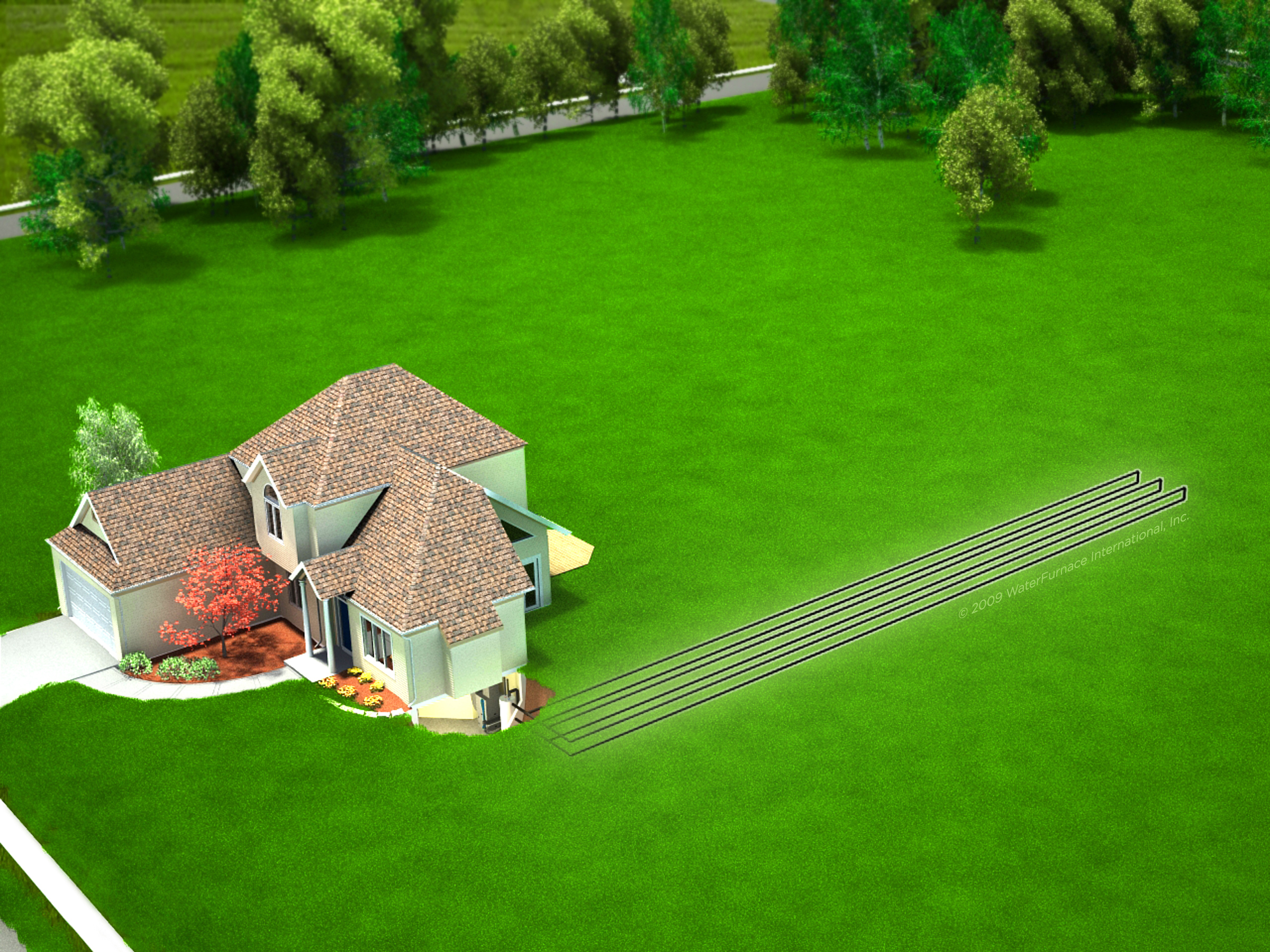
WaterFurnace illustration of horizontal loop for geothermal
Closed Vertical Loop
Vertical loops are an option when land surface available is limited. Well drilling equipment is used to bore 150mm diameter holes from depths of 60 – 120m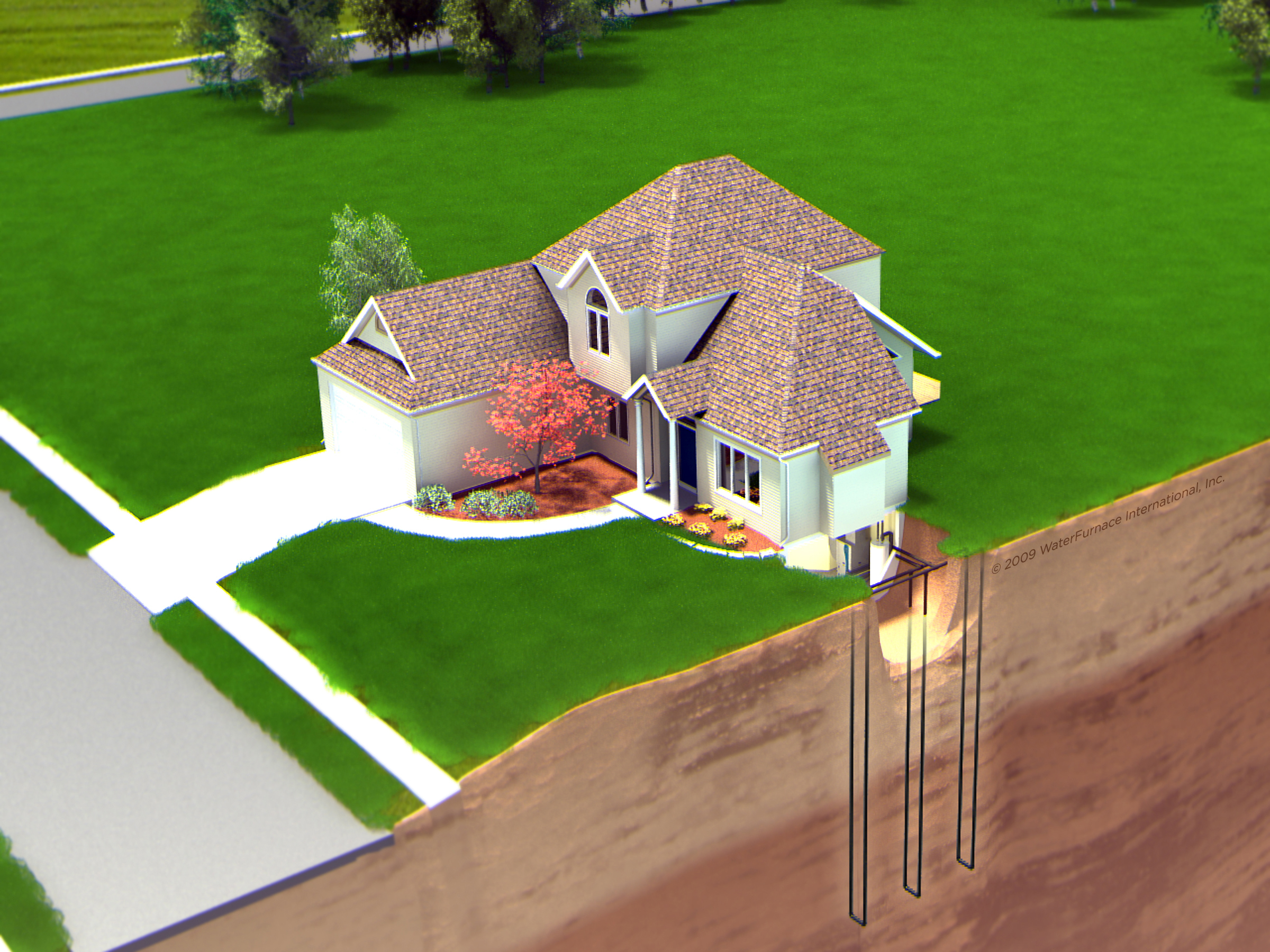
WaterFurnace illustration of vertical loop for geothermal
Pond / Lake
Pond/Lake Loops are economical to install when a body of water is available because excavation costs are eliminated. Coils of pipe are placed at the bottom of a lake.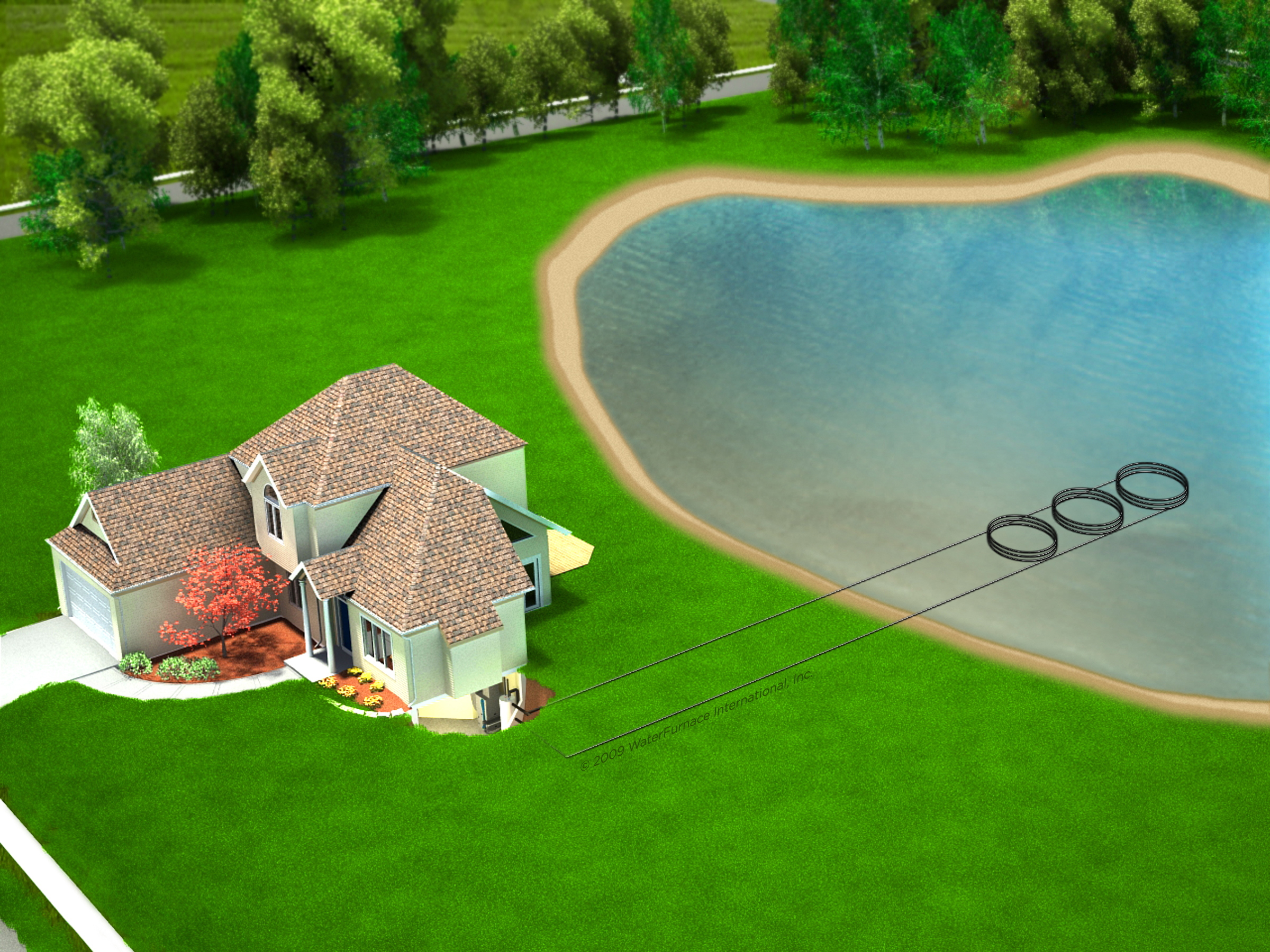
WaterFurnace illustration of pond loop for geothermal
Open Loop
Open Loop systems utilize ground water as a direct energy source. In ideal conditions, an open loop application is the most economical type of geothermal system. Although predominantly used for commercial or farm applications these can be economically used where the water table is high.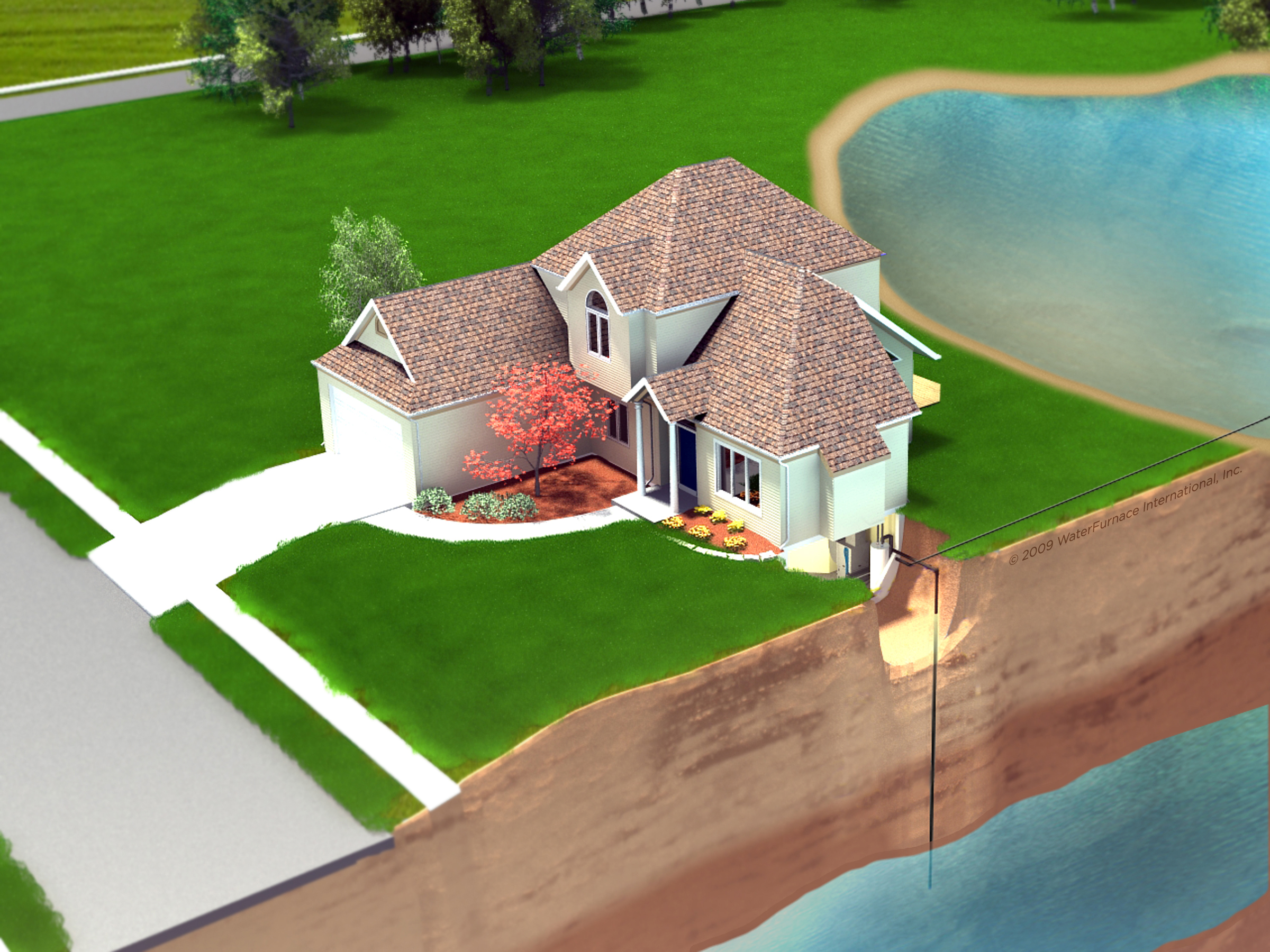
WaterFurnace illustration of open loop for geothermal